

From a High School Auditorium to a Lasting Landmark: The Founding of St. Thomas Becket Parish in Cheshire


By Richard "Reggie" Smith Research/Editor Cheshire Ct Phoenix News
When Cheshire experienced one of its greatest periods of residential growth during the late 1960s and early 1970s, the town's Catholic community faced a new challenge. Families settling in South Cheshire found themselves traveling farther to attend services at St. Bridget's. Recognizing the need for a parish closer to home, the Archdiocese of Hartford launched what would become Cheshire's third Catholic parish—St. Thomas Becket Church.
A New Mission for a Growing Community
In May 1970, Archbishop John F. Whealon officially authorized the creation of a new Catholic mission to serve southern Cheshire. The mission initially remained under the guidance of St. Bridget's Parish while plans for a permanent church were developed.
The Archdiocese selected Rev. Kenneth J. Frisbie as its founding pastor. A native of Bridgeport, Father Frisbie studied at St. Thomas Seminary in Bloomfield and St. Mary's Seminary in Baltimore before being ordained to the priesthood on May 6, 1948, at St. Joseph Cathedral in Hartford.
Without a church building of its own, the fledgling congregation began celebrating Sunday Mass in the Cheshire High School auditorium in June 1970. Parishioners gathered each week in the school, transforming the auditorium into a place of worship while volunteers handled everything from setup to religious education.
The mission quickly flourished.
On March 25, 1971, less than a year after its founding, Archbishop Whealon elevated the mission to the status of an independent parish. Named in honor of St. Thomas Becket, the 12th-century Archbishop of Canterbury and martyr, the new parish already served more than 500 families, with Father Frisbie appointed as its first pastor.

Building a Parish Community Before Building a Church
Although the congregation lacked a permanent home, parish life was remarkably active.
Church organizations formed almost immediately, including a thriving Mr. and Mrs. Club, which organized dances, social gatherings, and community events that helped bring together families who were meeting one another for the first time.
One popular event was the club's "Fun Night, Country Style," featuring round and square dancing at St. Bridget Hall with caller Ralph Knowlton. The evening was organized by parish volunteers including Mrs. Richard Ziegler, Mrs. Ralph Celella, and Mrs. Carmine Landisio.
Religious education also became a priority. Among the early volunteers was Mrs. Patricia Marcotte Romano, who organized the parish's first Confraternity of Christian Doctrine (CCD) program and helped establish religious instruction for dozens of young parishioners. Her work laid the educational foundation for future generations before her untimely death in an automobile accident in late 1972.

Selecting the Perfect Location
As membership continued to climb, Father Frisbie and parish leaders searched for land that would serve the growing congregation.
In September 1971, the parish announced it had secured an option on approximately six acres along North Brooksvale Road, directly across from Norton School.
The location was chosen because it sat near the geographic center of parish boundaries, allowing many parishioners to walk to church while providing room for future growth.
To design the new church, the parish selected architects John Pacelle and Donald DeStefano of Southington.
Rather than constructing a traditional Gothic or Romanesque church, the architects embraced the spirit of the post-Vatican II Church by creating a modern, multi-purpose building that could accommodate worship, religious education, meetings, and community events under one roof.
The proposal reflected a new philosophy in Catholic architecture—one emphasizing participation, flexibility, and openness.
Before construction could begin, the project required town approval.
In March 1972, Cheshire Town Planner William Blitz conducted a public hearing on the parish's special permit application. The proposal received community support and the necessary approvals, clearing the way for construction.
Breaking Ground
On June 4, 1972, nearly 1,000 parishioners gathered after the afternoon Mass for the ceremonial groundbreaking.
Father Frisbie was joined by parish trustees Joseph F. Barba and John Vanhaaften in turning the first shovels of earth.
The ceremony quickly became a community celebration. Families enjoyed a large parish picnic complete with games, contests, pony rides, and even a clown, underscoring the excitement surrounding Cheshire's newest parish.
Construction was awarded to M. A. Pomponio and Son of Waterbury.
The church's original construction contract totaled approximately $375,000. Once furnishings and interior appointments were included, the completed project represented an investment of roughly $450,000—a substantial commitment by a young congregation.
A Modern Church for a New Era
When construction neared completion in 1973, parishioners were greeted by one of the most architecturally distinctive churches in Cheshire.
The building featured a dramatic stained-glass mosaic covering the upper portion of its front façade, created by the noted artistic team of Jonyas and Shepherd of Hollis, New York.
Inside, the sanctuary reflected the liturgical changes introduced after the Second Vatican Council.
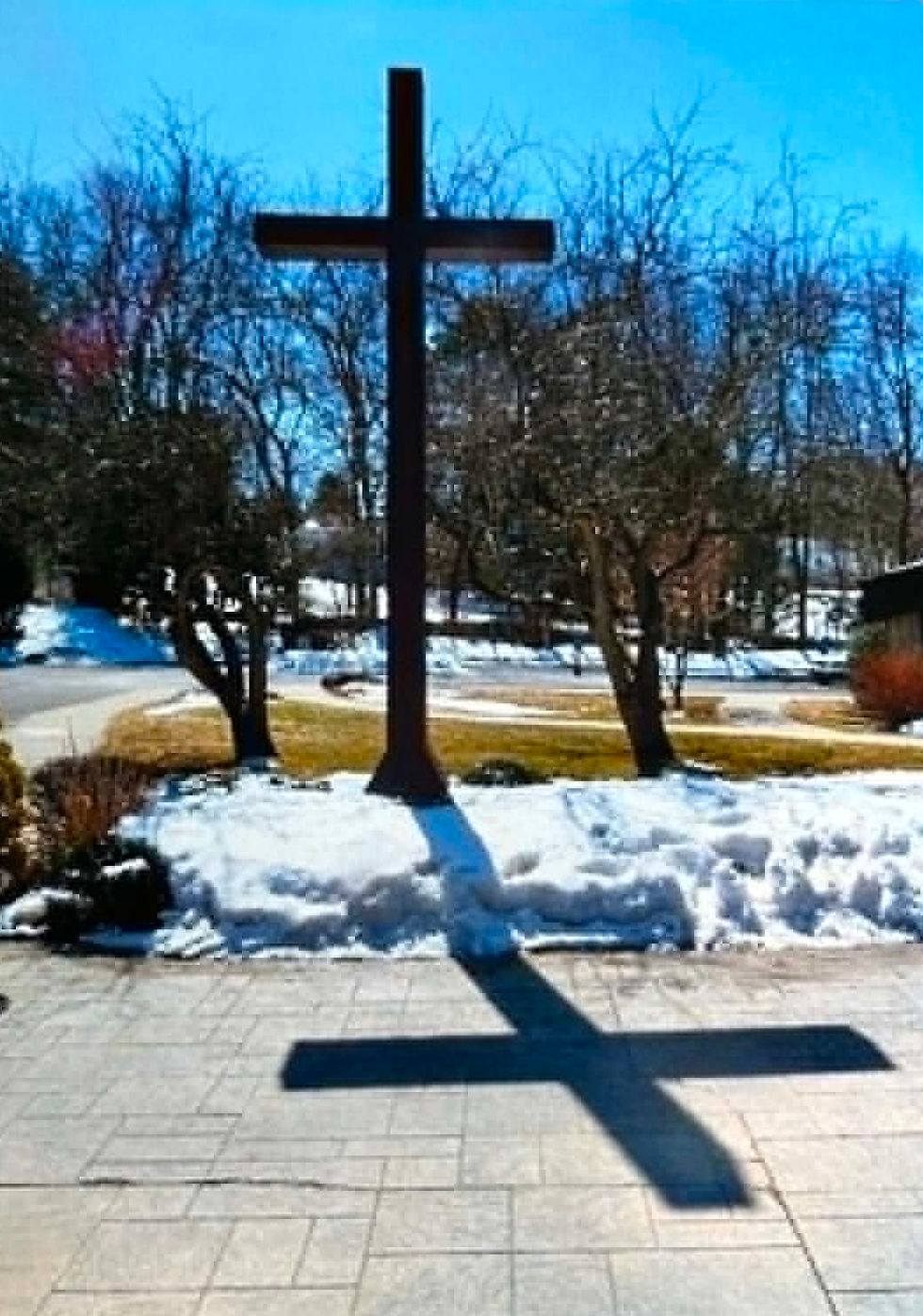
Suspended above the altar hung an innovative wooden cross portraying the Risen Christ rather than the traditional crucified figure, emphasizing resurrection and hope.
Instead of carved Stations of the Cross, the walls displayed beautifully hand-woven tapestry scrolls created by Sister Maria Edward of the Sisters of Mercy in Madison, Connecticut, giving the sanctuary a distinctive artistic character.
The First Mass
On May 27, 1973, St. Thomas Becket Parish celebrated its first Mass in the completed church.
The Thanksgiving liturgy also marked the 25th anniversary of Father Frisbie's ordination, making the day especially meaningful for the founding pastor who had guided the parish from its earliest days in the high school auditorium.
Following the Mass, parishioners celebrated with a festive champagne brunch, commemorating both milestones.
A Historic Dedication
The parish's official dedication came several months later.
On September 30, 1973, Archbishop John F. Whealon returned to Cheshire to solemnly bless and dedicate St. Thomas Becket Church.
The dedication Mass filled the new sanctuary with parishioners and visiting clergy from throughout the Archdiocese.
Joining Archbishop Whealon at the altar were:
Rev. Kenneth J. Frisbie, founding pastor of St. Thomas Becket.
Rev. Arthur P. Hanley, pastor of St. Bridget of Sweden Parish, the parish from which St. Thomas Becket had grown.
Rev. Eugene Torpey, pastor of Epiphany Parish.
The liturgy included Permanent Deacon Edward J. Fimle, while music was provided by John Romano, Reinhold Bekeler, Todd Lee, the Parish Folk Group, and the Parish Chorale.
Interestingly, the dedication coincided with another important event in town history. Cheshire was celebrating the acquisition of the historic Farmington Canal Lock, located adjacent to the church property. To avoid overwhelming traffic in the area, town officials coordinated the canal celebration on the Town Green while hundreds of worshippers attended the dedication on North Brooksvale Road.
A Lasting Legacy
What began in 1970 with Sunday Masses held in a high school auditorium quickly became one of Cheshire's enduring institutions.
The story of St. Thomas Becket Parish is about far more than the construction of a church building. It is the story of volunteers setting up folding chairs each week, parents building religious education programs from scratch, families organizing social events to strengthen a new community, and parishioners investing their time, talent, and resources into creating a spiritual home.
More than fifty years after Archbishop Whealon established the mission, St. Thomas Becket continues to serve generations of Cheshire families—standing as a lasting reminder of a period when the town itself was growing, changing, and building for the future.

Editors Note: The physical campus of St. Thomas Becket Church in Cheshire closed officially in early 2025.
Its transition happened in two major phases:
The Parish Merger (2017): First, the parish of St. Thomas Becket ceased to operate as an independent entity in 2017 when it merged with Cheshire’s Epiphany and St. Bridget churches to form the unified Saint Bridget of Sweden Parish. The St. Thomas Becket building on North Brooksvale Road continued to be used as a campus for the combined parish for several years.
The Official Sale and Building Closure (2025): In February 2025, the pastor, Rev. Jeffrey V. Romans, announced the official decision to close and sell the St. Thomas Becket campus due to high operating and capital repair costs (which had exceeded $1 million over the preceding six years).
Following its closure, the church building and its property were sold to the Cheshire YMCA for $2.53 million. By 2026, the building had transitionally opened as a new YMCA facility.


Comments