

From Cheshire's Soccer Fields to the World Stage: The Remarkable Journey of Sunil Gulati

CHESHIRE CT PHOENIX NEWS
How a Cheshire teenager helped build local soccer—and later helped shape the future of the game in America
By Richard "Reggie" Smith Research/Editor

CHESHIRE, Conn. — Every town has its hometown success stories. Some become business leaders, educators, military heroes, or public servants. Cheshire can also claim one of the most influential figures in the history of American soccer.
Long before he helped shape Major League Soccer, led the United States Soccer Federation, or sat on FIFA's Executive Committee, Sunil Gulati was simply a Cheshire teenager who loved the game of soccer.
In the mid-1970s, soccer was still finding its footing in Connecticut. Baseball, football, and basketball dominated youth sports, and organized soccer opportunities were limited. Rather than accept the lack of opportunities, Gulati helped create them.
It was the beginning of a journey that would eventually take him from Cheshire's playing fields to the highest levels of international soccer.
Building Soccer in Cheshire

Sunil Gulati was born in Allahabad, India, on July 30, 1959. After immigrating to the United States with
his family, they eventually settled in Cheshire in 1970.
The timing was significant.
Soccer was beginning to grow throughout New England, but organized youth programs were still in their infancy. Cheshire was no exception.
As a young teenager, Gulati wasn't content simply to play.
By age twelve he was already coaching younger children, helping introduce five- and six-year-olds to a sport that was still unfamiliar to many American families.
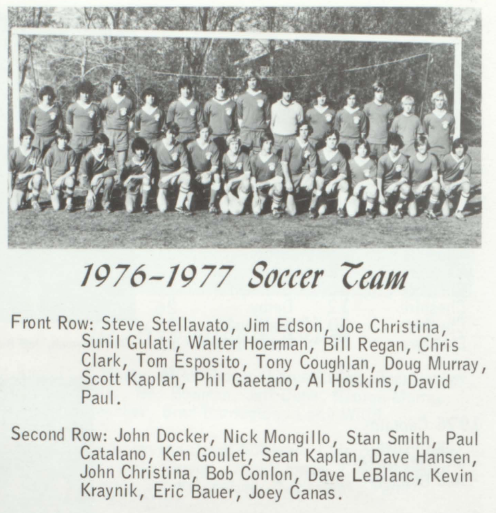
A few years later, while attending Cheshire High School, Gulati and fellow student Nick Mongillo discovered there wasn't an organized travel team for players in their age group.
Instead of giving up, they built one.
The two teenagers organized what became one of Cheshire's earliest U-16 travel soccer teams while also helping establish additional U-12 and U-14 teams. Those volunteer efforts became part of the foundation that eventually evolved into today's Cheshire Soccer Club, one of Connecticut's longest-running community soccer organizations.
For many longtime Cheshire families, those early seasons represented the grassroots beginning of a sport that would eventually become one of the town's most popular youth activities.
An Economist with a Soccer Vision
Although Gulati enjoyed playing, he recognized that his greatest strengths lay elsewhere.
After graduating from Cheshire High School, he attended Bucknell University, where he played junior varsity soccer before focusing increasingly on coaching and administration.
He later earned graduate degrees in economics from Columbia University, combining academic expertise with a lifelong passion for soccer.
That unusual combination would change the course of American professional soccer.
Helping Build Major League Soccer

Following the successful 1994 FIFA World Cup in the United States, Gulati served as Executive Vice President of the tournament's organizing committee.
The tournament's success helped pave the way for the launch of Major League Soccer (MLS) in 1996.
As MLS Deputy Commissioner, Gulati became one of the principal architects of the league's financial structure.
Having watched the original North American Soccer League collapse under uncontrolled spending during the 1980s, MLS adopted a different approach.
Instead of individual clubs competing financially without limits, the league operated as a single business entity, sharing financial risk while maintaining salary controls.
The system was unconventional, but it worked.
Thirty years later, Major League Soccer has grown into one of North America's major professional sports leagues, with expanding attendance, international stars, soccer-specific stadiums, and a rapidly growing fan base.
Many sports economists credit that early financial discipline as one of the key reasons MLS survived when many previous American soccer leagues failed.
Leading U.S. Soccer
In 2006, Gulati was elected President of the United States Soccer Federation, a position he held until 2018.
During those twelve years, American soccer experienced tremendous growth.
Among the highlights:
The U.S. Women's National Team won Olympic gold medals in 2008 and 2012.
The United States captured the 2015 FIFA Women's World Cup championship.
Youth participation continued to expand nationwide.
Professional soccer attendance reached record levels.
The United States successfully secured the joint bid with Canada and Mexico to host the 2026 FIFA World Cup.
In recognition of his decades of contributions, Gulati was inducted into the National Soccer Hall of Fame in 2019 as a "Builder," honoring those whose leadership transformed the sport off the field.
Navigating Difficult Times
No career at the highest levels of international sports comes without challenges.
During Gulati's tenure, FIFA became engulfed in the sweeping 2015 corruption investigation led by the U.S. Department of Justice.
Although Gulati served on FIFA's Executive Committee during that era, he was never charged with any crime, never indicted, and was never accused of accepting bribes.
Nevertheless, because he worked alongside several officials who were later indicted, questions were raised about how widespread corruption had persisted for so many years within international soccer.
At the same time, Gulati publicly supported governance reforms, advocated for greater transparency, voted against longtime FIFA President Sepp Blatter during the 2015 presidential election, and supported structural changes including term limits within U.S. Soccer.
His legacy, like that of many leaders overseeing large international organizations, reflects both significant accomplishments and the complexities of managing institutions during periods of major change.

Returning to the Classroom
Today, Gulati has returned to another lifelong passion—education.
As a senior lecturer in economics at Columbia University, he teaches courses including The Business of Sports, using decades of firsthand experience in sports management, economics, labor negotiations, media rights, and international competition to educate the next generation of sports executives.
Students learn not only economic theory, but also practical lessons from someone who helped shape modern American soccer.
A Cheshire Legacy
Today, thousands of children lace up their cleats each fall through Cheshire Soccer Club without realizing that one of the organization's earliest architects would go on to influence the sport across the globe.
From volunteer coach...
...to youth organizer...
...to economist...
...to architect of Major League Soccer...
...to President of U.S. Soccer...
...to member of FIFA's Executive Committee...
Sunil Gulati's journey began on local fields where community volunteers simply wanted every child to have a chance to play.
For Cheshire, his story serves as a reminder that extraordinary accomplishments often have remarkably ordinary beginnings.
Sometimes the road to the World Cup starts not in New York, London, or Zurich—but on a small soccer field in Cheshire, Connecticut.
Did You Know?
Sunil Gulati at a Glance
Born in India on July 30, 1959.
Moved to Cheshire with his family in 1970.
Attended Cheshire High School.
Helped organize some of Cheshire's earliest youth travel soccer teams.
Earned graduate degrees in economics from Columbia University.
Helped organize the successful 1994 FIFA World Cup in the United States.
Served as Deputy Commissioner of Major League Soccer.
President of the U.S. Soccer Federation from 2006–2018.
Helped secure the successful North American bid for the 2026 FIFA World Cup.
Inducted into the National Soccer Hall of Fame in 2019 as a "Builder."

Editor's Note
The Cheshire Ct Phoenix News believes local history extends beyond town boundaries. The accomplishments of Cheshire residents who have influenced state, national, and international affairs are part of our community's shared heritage. Sunil Gulati's career represents one of the most significant examples of a Cheshire resident helping shape an entire sport while never forgetting the grassroots volunteerism where his journey began.


Comments