

When Cheshire Out-Studded the State: The Grand Tercentenary of 1935


If you happened to be strolling past the Cheshire Green in August of 1935, you might have wondered if you’d stepped into a time machine or simply had one too many hard ciders down at the local grange. The entire town was swept up in a four-day whirlwind celebrating the 300th anniversary of the settlement of Connecticut (1635–1935). Organized under the tireless command of General Chairman Miss Nettie C. Smith and Committee Chairman Frederick S. Baker, the event proved that when it comes to honoring history, Cheshire doesn't just look back—it throws a party.
The Crier, The Judge, and The Missing Pageant
The festivities kicked off on Thursday, August 15, 1935, at 2:30 PM, heralded by the booming voice of Town Crier Alfred Ward. Gathering at the Congregational Church under the watchful eye of Paul T. Hotchkiss, Chairman of the Day, the townspeople listened to a series of welcoming addresses. Judge Carroll C. Hincks offered a stirring welcome, followed by friendly greetings from Judge John L. Gilson representing Wallingford—our "Mother Town"—and a humorous report on Prospect, our "Daughter Town," presented by Mr. Cowdell.
Not everything went exactly according to script, however. In a classic historical plot twist, the highly anticipated Children’s Pageant—scheduled for Saturday at the Roxbury Athletic Field—had to be completely canceled and postponed until spring. The culprit? A sudden outbreak of infantile paralysis (polio) in the neighboring towns. While the kids were undoubtedly disappointed, the rest of the town marched on.

From "Rag Hollow" to Grandfather Clocks
Friday, August 16, turned the spotlight onto Cheshire's historic industrial grit. Gathering at Bowden Hall with Charles C. Hall presiding, residents tracked the town’s evolution from an agricultural haven to a cradle of mechanical invention. Papers presented highlighted local icons like William Mix, who famously invented the rag buff wheel on the Ten Mile River, earning the valley its delightful local moniker, "Rag Hollow".
The crowds also marveled at stories of Reuben Merriman, who hand-built grand "Grandfather" clocks on the present site of the Congregational Church back in 1790, transporting them via mule team to wealthy planters in Virginia.
The day concluded with the absolute highlight of the weekend: a sprawling Costume Ball held at the Roxbury Gymnasium. At a steep admission price of one dollar per couple (or 50 cents single), locals donned heavy velvet coats, powdered wigs, and colonial gowns, dancing the night away into a collective historical heatwave.
An Exhibit to Envy
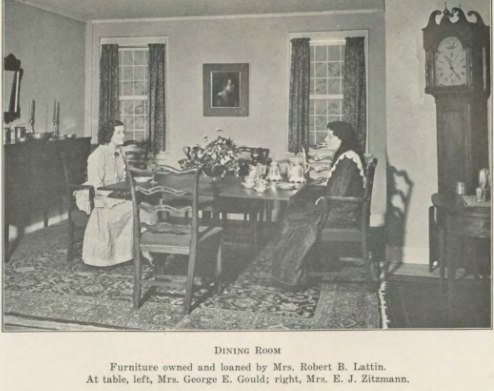
The crown jewel of the entire celebration was the Loan Exhibit housed at the Town Hall, meticulously guarded by C. R. Fossett and Edward J. Hart. Members of the Woman’s Club, dressed resplendently in the gowns of their ancestors, served as hostesses to nearly 1,500 registered guests representing 16 different states.
The exhibit featured three beautifully assembled replica Colonial rooms: a bedroom by Miss Alice W. Bassett, a dining room by Mrs. Robert B. Lattin, and a rustic kitchen by Mrs. Alfred F. Evans. Visitors gaped at ancient farming implements, rare prints, and local clocks. One well-traveled gentleman who made it a point to visit every single Tercentenary exhibit across Connecticut that year officially pronounced Cheshire’s display "the most satisfying of all".
By the time the final notes of Daniel Emke’s Cheshire Band echoed across the green on Sunday evening, the town had successfully linked its vibrant 20th-century present with its pioneering 17th-century past. Houses all over town were proudly marked with their construction dates, and a scion of the historic Charter Oak was firmly planted at St. Peter’s Church—a living monument to a weekend when Cheshire truly kept step with the times.
Download the Original 1935 Program Booklet
Want to dive deeper into the exact names, schedules, and historical papers that shaped this momentous weekend? You can download the complete, original commemorative booklet from the celebration, titled "30002_21753069.pdf".
Inside this historical digital document, you will find:
The Official Four-Day Program: A complete schedule of events, from the Town Crier's opening call to the exact musical numbers performed on the green.
Revolutionary War Rolls: An incredibly detailed list of Cheshire men who served in the War for Independence, including their names, ranks, and exact units.
Industrial & Agricultural Timelines: Fascinating essays compiled by local historians detailing our town's early factories, "Rag Hollow" inventions, and the legendary barytes mining boom.
A Directory of Historic Homes: A chronological list of Cheshire's oldest standing homesteads, marked with their original construction dates and original owners.
Cheshire's celebration of the three hundredth anniversary of the settlement of Connecticut, 1635-1935.


Comments